
Last Updated on 3rd May 2026
April 2026 has been a transformative month for social media marketing. The overarching theme across all major networks is a definitive push toward rewarding pure originality while using artificial intelligence to remove the friction of discovery and content creation. The era of growth hacking through reposting viral clips is officially over, replaced by algorithmic mandates that demand authentic, native, and highly specialized content.
Here is our agency roundup of the critical social media marketing shifts that occurred in April 2026 and exactly what you need to do about them.
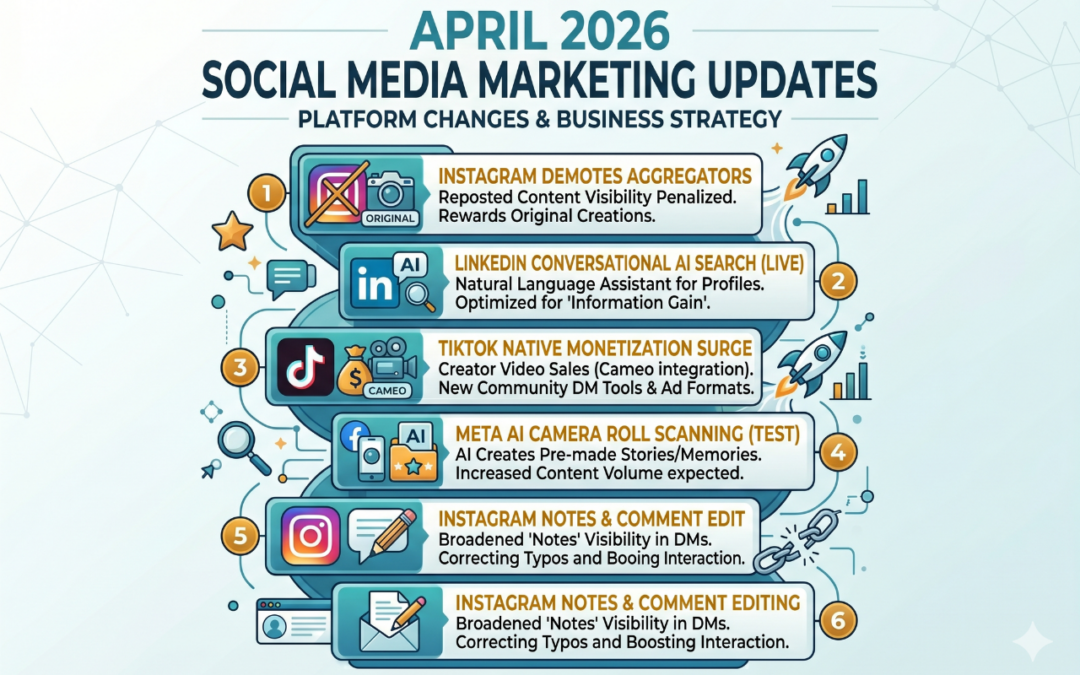
1. Instagram’s Algorithm Update: The Fall of the Aggregator
In a massive structural update rolled out in late April, Instagram completely overhauled its ranking system to aggressively benefit original creators. The platform is now actively demoting “aggregator” accounts—profiles that primarily repost other people’s photos and videos. If an account is flagged for posting predominantly third-party content without adding substantial original value, it will lose its reach in the Explore page and Reels feed.
What It Means for Business Owners
The standard “curation” playbook is officially dead on Instagram.
-
Rethink your UGC strategy: If your brand relies heavily on reposting User-Generated Content (UGC), you must ensure you are adding significant, undeniable value to the post (such as extensive editing, voiceovers, or unique visual commentary). Simply downloading a customer’s Reel and posting it to your feed will now hurt your overall account health.
-
Double down on original production: Brands must invest in producing their own native content. The algorithm is now heavily skewed to reward the first account that uploads a piece of media, meaning the ROI on original brand shoots and bespoke creator partnerships has never been higher.
2. Instagram Tests Clickable Links in Captions
In a massive shift for organic social media strategy, April 2026 saw Meta begin testing clickable links directly within Instagram post captions for select Meta-verified creators. Historically, Instagram has forced users into the cumbersome ‘link in bio’ workflow to drive off-platform traffic.
What It Means for Business Owners
Frictionless social commerce is inching closer to reality on Instagram.
- Rethink your organic social strategy. While still in the testing phase, this signals the end of the ‘link in bio’ era. Once rolled out widely, businesses will be able to drive direct-response traffic straight from their feed posts.
- Focus on caption copywriting. As links become native to captions, your social media copy needs to transition from purely brand-building language to incorporating strong, direct Calls to Action (CTAs). Start testing shorter, punchier copy now so you are prepared when the feature becomes available to standard business accounts.
3. LinkedIn’s Conversational AI Search Goes Mainstream
After an initial Premium-only launch, LinkedIn officially expanded its AI-powered “Conversational Search” to all users this April. The traditional, rigid search bar has been replaced by a natural language assistant. Users can now type complex queries like, “Find me a freelance B2B copywriter in the UK who has experience in the SaaS industry,” and the AI will scan profiles to deliver highly contextual matches, complete with “Smart Summaries” explaining why a specific person or business is a relevant fit.
What It Means for Business Owners
Keyword stuffing your LinkedIn company page or personal profile is no longer an effective visibility strategy.
-
Optimize for natural language: Because LinkedIn’s search is now parsing the context of your profile rather than just matching exact words, your headline, “About” section, and company description must be written in clear, conversational English.
-
Focus on verified skills: Ensure your profile has verified skills and clear experience markers. The AI prioritizes credible, well-documented profiles when generating its Smart Summaries for searchers.
4. TikTok’s Ecosystem Lock-In: Cameo, AI Memes, and DMs
TikTok spent April 2026 rolling out features designed to keep users and creators entirely within its walls. The platform introduced a native AI Meme Generator, launched interactive emoji games inside Direct Messages to boost private sharing, and most notably, announced a partnership with Cameo. Creators can now sell personalized videos to fans directly inside the TikTok app, drastically shortening the distance between content creation and monetization. Furthermore, they launched new high-impact ad formats like “Prime Time” and “Logo Takeover.”
What It Means for Business Owners
TikTok is rapidly evolving from a discovery engine into a closed-loop economy.
-
Explore native influencer monetization: With creators now able to monetize directly through the app via features like the Cameo integration, brands should look for ways to sponsor or subsidize these interactions to build massive goodwill with a creator’s audience.
-
Shift to community building: The introduction of DM games and subscriber-only stories highlights a push toward private, community-led engagement. Brands should focus on creating content that users want to share directly with their friends in DMs, rather than just optimizing for the public “For You” page.
5. Meta’s “Opt-In Camera Roll Scanning”
In one of the most debated updates of the month, Meta began testing an opt-in feature in the UK that allows Facebook to scan a user’s smartphone camera roll. Using AI, the app automatically sifts through clutter to find “standout memories,” automatically generating pre-made collages, stories, and videos for the user to review and post with zero editing effort.
What It Means for Business Owners
The volume of content on Facebook and Instagram is about to explode.
-
Prepare for increased noise: By removing the friction of content creation for the average user, Meta is ensuring feeds will be flooded with AI-curated personal memories. Organic brand content will have an even harder time competing for attention.
-
Elevate your creative standard: To stand out in a feed full of perfectly AI-edited personal montages, your brand’s creative must be exceptionally thumb-stopping, entertaining, or deeply educational. “Good enough” design will be scrolled past immediately.
6. Instagram Expands “Notes” and Rolls Out Comment Editing
Instagram finally answered one of its most requested quality-of-life updates by allowing users to edit published comments. More strategically, Instagram expanded its “Notes” feature—the short, 60-character status updates that sit at the top of the DM inbox. Previously limited to “Close Friends” or mutual followers, Notes can now be broadcasted to a user’s entire audience.
What It Means for Business Owners
You have a new, highly visible touchpoint that doesn’t require high-budget production.
-
Leverage Notes for immediate updates: Because Notes live directly in the inbox, they offer a highly visible, non-intrusive way to stay top-of-mind. Use Notes to drop flash sale codes, tease upcoming product drops, or ask quick engagement questions without cluttering your main feed or Stories.
-
Encourage community interaction: With the ability to edit comments, users are more likely to leave longer, more thoughtful replies without the fear of a permanent typo. Foster this by asking open-ended questions in your captions to drive deeper comment section discussions.
The Bottom Line in Social Media Marketing for April 2026
April 2026 made it crystal clear: the platforms are using AI to clean up their ecosystems. They are burying unoriginal aggregators and making it easier than ever for everyday users to post and search conversationally. For brands, the mandate is simple—stop trying to hack the algorithm with copied content and start investing in genuine, high-quality, original community building.
More to Explore
April 2026 Digital Marketing Industry Updates

30 Powerful Competitor Analysis Tools
The Power of Content Analysis in Digital Marketing
Content Marketing Statistics & Insights [Updated for 2024]

Conversational Search (Voice Search) and…

Social Media Marketing Guide

How To Track Revenue In Social Media Networks

UK National Days, Digital PR & Content Calendar 2026

Verifying A Google Search Console Domain Property…