
Last Updated on 3rd May 2026
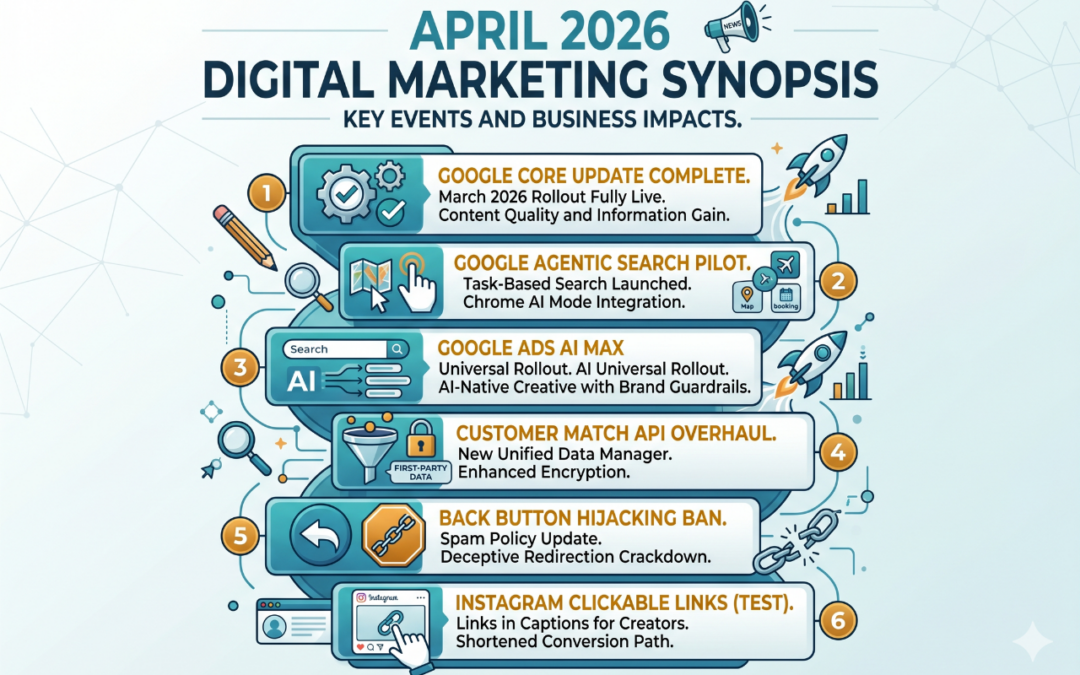
Here is a breakdown of key digital marketing events across SEO, paid search and social media marketing that specifically occurred in April 2026. The landscape continues to shift heavily toward AI automation and task-oriented search this month, demanding immediate strategic adjustments from brands.
SEO Industry Updates April 2026
1. The Completion of the March 2026 Google Core Update
On April 8, 2026, Google officially completed the rollout of its March 2026 Core Update. This update fundamentally recalibrated how the search engine evaluates relevance to queries and query intent and is periodically updated and appears to be heavily rewarding complete topic coverage and verifiable data whilst aggressively demoting thin, generic summaries and AI-spun roundups.
What It Means for Business Owners
If your organic traffic fluctuated in mid-April, the dust has finally settled, and you can now accurately assess your new baseline.
- Stop reacting and start auditing. A drop in rankings does not necessarily mean you have an algorithmic penalty. It can simply mean a competitor’s content was deemed more useful or comprehensive or their focus was more aligned with the intent of searchers for specific queries.
- Focus on Adding Value Search engines are heavily rewarding original research, expert quotes, and unique perspectives. If your blog posts simply summarise what is already ranking on page one, you may continue to lose visibility. Audit your top 20 pages and ask yourself honestly “Does this answer the user’s question better than anyone else, or is it just word salad and fluff?”
2. Google Pilots ‘Agentic Search’ and Chrome AI Mode Integrations
April 2026 marked the undeniable shift from simple ‘informational search’ toward ‘action-oriented search’. Google launched a live US pilot of Task-Based Agentic Search (TBAS), meaning AI doesn’t just return links for users to browse, it executes tasks. Users can now prompt Google to plan an itinerary, track hotel prices, and even have Google’s AI call local stores to check product inventory. Additionally, Google announced that AI Mode is being integrated directly into the Chrome address bar, allowing users to query AI while referencing open tabs and files.
What It Means for Business Owners
You are no longer just optimising for human readers you must consider agentic journey optimisation into the future.
- Make sure your data is machine-readable. If an AI agent is potentially going to book a table, check your inventory, or schedule a service on behalf of a user in the future, your pricing, availability, and business data must be perfectly accessible and ideally structured via Schema markup, strong internal link connections and accessible APIs.
- Update your Google Business Profile. If Google’s AI is potentially calling your store or scraping your local listings to answer user queries, out-of-date hours or inventory may well disqualify you from being recommended by the AI assistant.
3. Google Explicitly Bans ‘Back Button Hijacking’
In a targeted spam policy update this April, Google announced a strict crackdown on ‘back button hijacking’ which is a deceptive UX practice where sites use redirect scripts or aggressive pop-ups to trap users and prevent them from using their browser’s back button to return to the search results.
What It Means for Business Owners
Search engines are becoming ruthless about penalising poor user experiences.
- Audit your pop-ups and scripts. Check your lead-generation overlays, exit-intent pop-ups, and redirection plugins. If any of your website’s scripts interfere with a user’s ability to easily navigate away from your page, you are at risk.
- Prepare for June. Google has stated that automated demotions and manual spam actions for this violation will begin on June 15, 2026. Ensure your web development team clears any problematic code before this deadline to avoid a drop in traffic.
Paid Search Industry Updates April 2026
April 2026 has been a foundational month for Paid Search. As the ecosystem becomes increasingly automated, the major ad networks—led heavily by Google Ads—have rolled out structural updates that change how we target users, manage data, and write ad copy. The overarching theme for this month is a definitive move away from legacy manual inputs toward hyper-efficient, AI-driven campaign management.
1. The Customer Match API Overhaul (April 1 Deadline)
On April 1, 2026, Google officially sunset the ability to upload Customer Match lists using the older Google Ads API (specifically OfflineUserDataJobService and UserDataService). Moving forward, all advertisers are required to use the new unified Data Manager API to ingest first-party data. This new protocol centralizes data ingestion across all Google services and introduces heavy encryption and confidential matching to comply with tightening global privacy frameworks.
What It Means for Business Owners
If your first-party audience lists suddenly stopped updating in early April, this is why.
-
Audit your CRM integrations: Any automated pipelines feeding customer lists into Google Ads that haven’t been updated to the Data Manager API are currently returning errors. Your developer tokens must be transitioned immediately.
-
Prioritize technical oversight: With third-party cookies functionally obsolete, keeping your Customer Match lists fresh is the only way to train Google’s bidding algorithms. Ensure your tech stack is compliant with this new API to keep your retargeting, exclusion, and lookalike campaigns running efficiently.
2. Dynamic Search Ads (DSA) Auto-Upgrading to “AI Max”
On April 15, 2026, Google announced the upcoming auto-upgrade of legacy features like Dynamic Search Ads (DSA) into the new AI Max framework. Rather than acting as a standalone campaign type, AI Max operates as an intelligent layer over existing Search campaigns. It expands your reach by dynamically finding search queries beyond your exact keywords and automatically tailors ad copy and landing page routing based on real-time user intent and generative AI capabilities.
What It Means for Business Owners
The rigid control of exact-match keyword targeting is being rapidly phased out in favor of contextual, AI-driven targeting.
-
Prepare for a broader net: AI Max will find high-converting queries you would have never thought to bid on, but it will also test irrelevant waters. You must be much more aggressive with your negative keyword lists to protect your budget.
-
Optimize the entire site: Because AI Max dictates which landing page a user is sent to based on their query, your entire website must be optimized for conversions, not just a few specific funnel pages.
3. Real-Time Policy Reviews for Responsive Search Ads
On April 16, 2026, Google introduced a massive quality-of-life update for media buyers: Real-Time Policy Reviews. Instead of submitting new ad creative and waiting hours (or sometimes days) for approval, the Google Ads interface now uses AI to provide instant feedback as you build your Responsive Search Ads (RSAs). Review times have been reduced from hours to mere seconds.
What It Means for Business Owners
Campaign agility just increased exponentially.
-
Faster speed-to-market: If you need to launch a flash sale or react to a competitor’s offer, you no longer have to build in a 24-hour buffer for Google’s policy bots to approve your ads.
-
Fewer account suspensions: By catching minor policy violations (like capitalization rules, restricted medical terms, or punctuation errors) during the drafting phase, advertisers reduce the risk of accumulating policy flags that can throttle campaign performance or lead to an account suspension.
4. The Launch of the “Results” Tab for Recommendations
A major frustration with Google’s automated “Recommendations” has historically been the lack of accountability. In April 2026, Google solved this by launching a dedicated Results tab directly within the Recommendations section. This new dashboard provides measurable visibility into what actually happens after you apply an automated suggestion, tracking the exact lift (or drop) in clicks, conversions, and costs.
What It Means for Business Owners
You can finally grade Google’s homework.
-
Measure the impact of automation: Before this, applying an auto-recommendation felt like a leap of faith. Now, you can objectively see if Google’s suggestion to “raise your CPA target” or “add new broad match keywords” actually generated a positive ROI.
-
Refine your Auto-Apply settings: Use this data to determine which types of recommendations consistently work for your specific business niche, and which ones you should permanently ignore or disable from your Auto-Apply settings.
5. Performance Max Gets Asset Experiments and Seasonal Theming
On April 20, 2026, Google rolled out highly anticipated controls for Performance Max (PMax) campaigns: Asset Experiments and Seasonal Creative Theming. Advertisers can now run true A/B tests on specific creative assets within PMax. Additionally, the new seasonal theming feature allows advertisers to temporarily align ad creatives and messaging with specific holidays or promotional periods without disrupting the learning phase of their core “always-on” campaigns.
What It Means for Business Owners
Performance Max is slowly becoming less of a “black box.”
-
Stop guessing and start testing: You no longer have to throw a mix of videos and images into PMax and hope for the best. You can now scientifically test which visual assets are driving the highest quality leads or lowest cost-per-acquisition.
-
Seamless holiday promotions: For e-commerce brands, the seasonal theming tool means you can push a “Mother’s Day Sale” or “Spring Clearance” message dynamically across all Google networks without the risk of resetting your algorithm’s valuable historical data.
6. X (Twitter) Begins Phased Rollout of xAI-Powered Ads Manager
While Google dominated the month’s news, social PPC saw a major disruption as well. In April 2026, X began the phased rollout of a fundamentally rebuilt Ads Manager. Moving away from two decades of legacy infrastructure, the new ad delivery and targeting system is entirely powered by xAI retrieval and ranking algorithms, designed to dramatically improve ad relevance and performance tracking.
What It Means for Business Owners
It may be time to re-evaluate platforms you previously wrote off.
-
A potential performance marketing rival: Historically, X has been viewed strictly as a brand-awareness platform due to poor direct-response tracking. This structural rebuild suggests a pivot toward true performance marketing.
-
Test small budgets first: If your audience lives on X, consider allocating a small test budget to the new Ads Manager over the coming months. If the xAI algorithms can deliver targeted leads at a lower CPC than Meta or Google, it could provide a highly lucrative first-mover advantage.
7. Google Ads Universally Rolls Out ‘AI Max’ Text Guidelines
After months of beta testing, Google made AI Max text guidelines universally available to all Search advertisers in April 2026. Previously, relying on Google’s AI to generate ad copy meant risking off-brand messaging. Now, advertisers can set strict guardrails around brand voice, tone, and specific phrasing, allowing the AI to optimize for conversions dynamically while staying within approved boundaries. Alongside this, Google introduced new shopping and travel ad formats that appear directly inside conversational AI Mode queries.
What It Means for Business Owners
The role of the media buyer has permanently shifted from manual keyword tweaking to feeding the algorithm the right parameters.
- Implement guardrails immediately. If you held off on AI-driven ad generation due to brand safety concerns, you can now safely deploy AI Max. Provide the AI with your brand guidelines and let it handle the micro-optimisations.
- Embrace broad match and automation. To be eligible for the highly lucrative new ad placements inside AI Mode, your campaigns must utilise AI Max, Performance Max, or Broad Match targeting. If you stubbornly stick to exact-match keywords, you are locking yourself out of the fastest-growing ad inventory on the internet.
The Bottom Line on PPC and Paid Search April 2026 Updates
The PPC updates of April 2026 prove that manual button-pushing is obsolete. Whether you are navigating the transition to AI Max, adopting the new Data Manager API, or testing PMax asset experiments, your success now depends entirely on the quality of the data and creative you feed the machine.
Are your ad accounts ready to leverage these new tools? Let’s discuss how to transition your PPC strategy from legacy manual bidding to a high-performance, AI-driven growth engine. Reach out to our team today for a comprehensive paid media audit.
More to Explore
April 2026 Social Media Pulse: Originality Mandates,…

UK National Days, Digital PR & Content Calendar 2026

History of Google Algorithm Updates

Why Digital Marketing Needs Collaboration

Black Friday Digital Marketing Ideas

20 Tools for Content Analysis in Digital Marketing
The Power of Content Analysis in Digital Marketing

Leveraging The Friday Feeling With Digital Marketing

Key Drivers Of Digital Marketing Acquisition…

30 Must-Have Google Chrome Extensions for Marketing